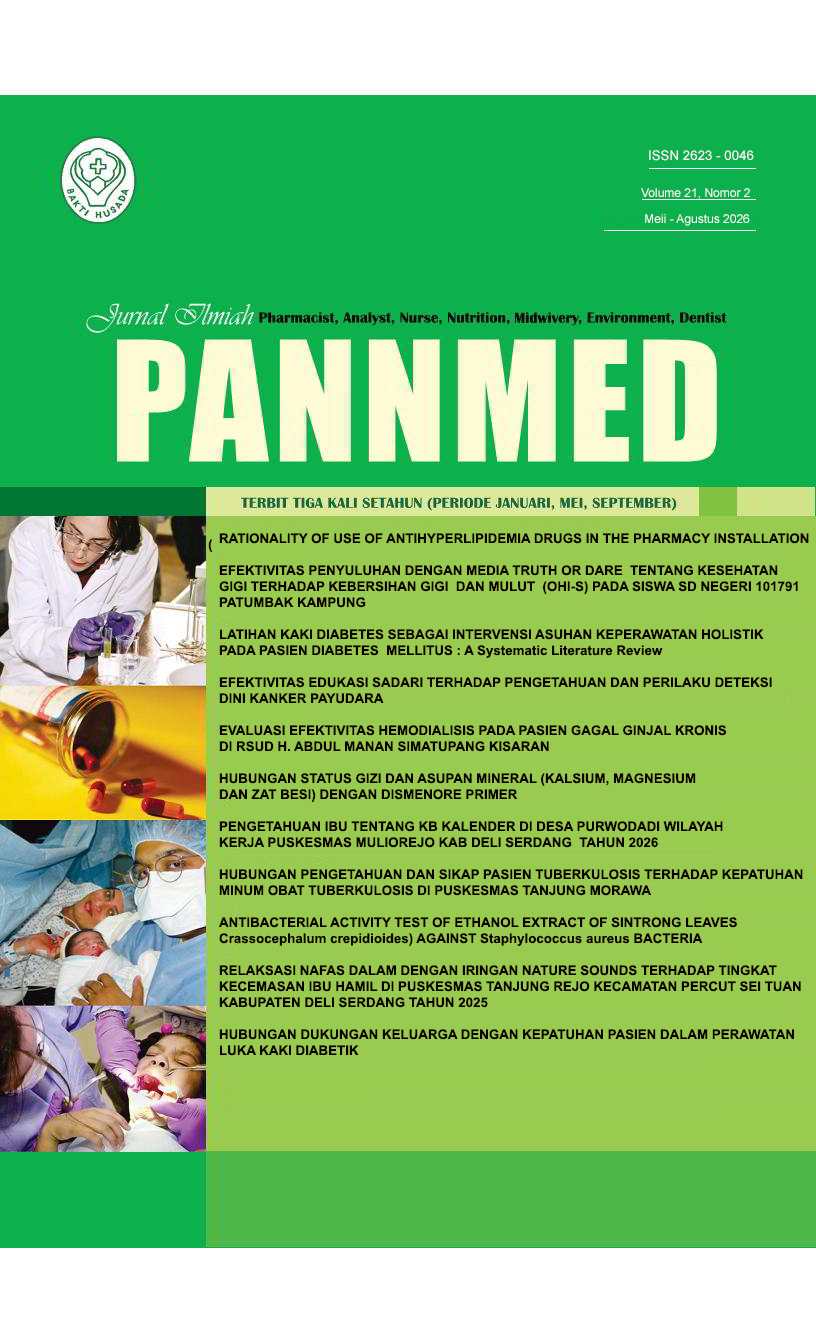
HUBUNGAN STATUS GIZI DAN ASUPAN MINERAL (KALSIUM, MAGNESIUM DAN ZAT BESI) DENGAN DISMENORE PRIMER
DOI:
https://doi.org/10.36911/pannmed.v21i2.2635Keywords:
nutritional statusAbstract
Primary dysmenorrhea is menstrual pain commonly experienced by adolescent girls and can interfere with daily activities and the learning process at school. Nutritional status and adequate intake of minerals particularly calcium, magnesium, and iron are factors believed to be associated with the occurrence of primary dysmenorrhea. This study aims to analyze the relationship between nutritional status and the intake of calcium, magnesium, and iron with the incidence of primary dysmenorrhea among adolescent girls at Tenggarang State High School 1, Bondowoso Regency. This study employed a quantitative correlational design with a cross-sectional approach. The study sample consisted of 86 female students in grades 10 and 11, selected using proportional stratified random sampling. Nutritional status data were obtained through anthropometric measurements and calculated based on age-adjusted body mass index (BMI-for-age). Data on calcium, magnesium, and iron intake were obtained using a non-consecutive 2×24-hour food recall, while data on primary dysmenorrhea were obtained using the Numerical Rating Scale (NRS) questionnaire. Data analysis was performed using the Chi-Square test and Fisher’s Exact Test. The results showed a significant association between nutritional status (p=0.004; OR=5.86), calcium intake (p=0.016; OR=7.17), and iron intake (p=0.002; OR=10.47) and the incidence of primary dysmenorrhea. Meanwhile, magnesium intake did not show a significant association with the incidence of primary dysmenorrhea (p=0.76). It can be concluded that nutritional status, calcium intake, and iron intake are associated with the incidence of primary dysmenorrhea in adolescent girls, whereas magnesium intake is not associated. Adolescent girls are advised to maintain a normal
References
Pratiwi, KM, Harjanti. Mengenal Menstruasi dan Gangguannya. Sukabumi: CV Jejak (Jejak Publisher); 2024.
Nurfadillah H, Maywati S, Aisyah IS. Faktor-Faktor yang Berhubungan dengan Kejadian Dismenore Primer pada Mahasiswi Universitas Siliwangi. Jurnal Kesehatan Komunitas Indonesia. 2021;17(1). doi:10.37058/jkki.v17i1.3604
Widianti, Herliana, Gunardi. Hubungan Dismenore Primer Dengan Aktivitas Belajar Siswi SMK Bina Putra Nugraha Kadupandak Cianjur Jawa Barat Tahun 2023. Jurnal Riset Rumpun Ilmu Kesehatan. 2024;3(1). doi:10.55606/jurrikes.v3i1.2746
Fahmiah NA, Huzaimah N, Hannan M. Dismenorea dan Dampaknya terhadap Aktivitas Sekolah pada Remaja. Jurnal Keperawatan Profesional (KEPO). 2022;3(1). doi:10.36590/kepo.v3i1.307
Cherenack EM, Rubli J, Melara A, Ezaldein N, King A, Alcaide ML, et al. Adolescent girls’ descriptions of dysmenorrhea and barriers to dysmenorrhea management in Moshi, Tanzania: A qualitative study. PLOS Global Public Health. 2023;3(7). doi:10.1371/journal.pgph.0001544
Napu L afriani, Yusrah Taqiyah, Wa Ode Sri Asnaniar. Pengaruh Kompres Air Jahe terhadap Penurunan Dismenorea Primer pada Remaja. Window of Nursing Journal. 2023. doi:10.33096/won.v4i1.735